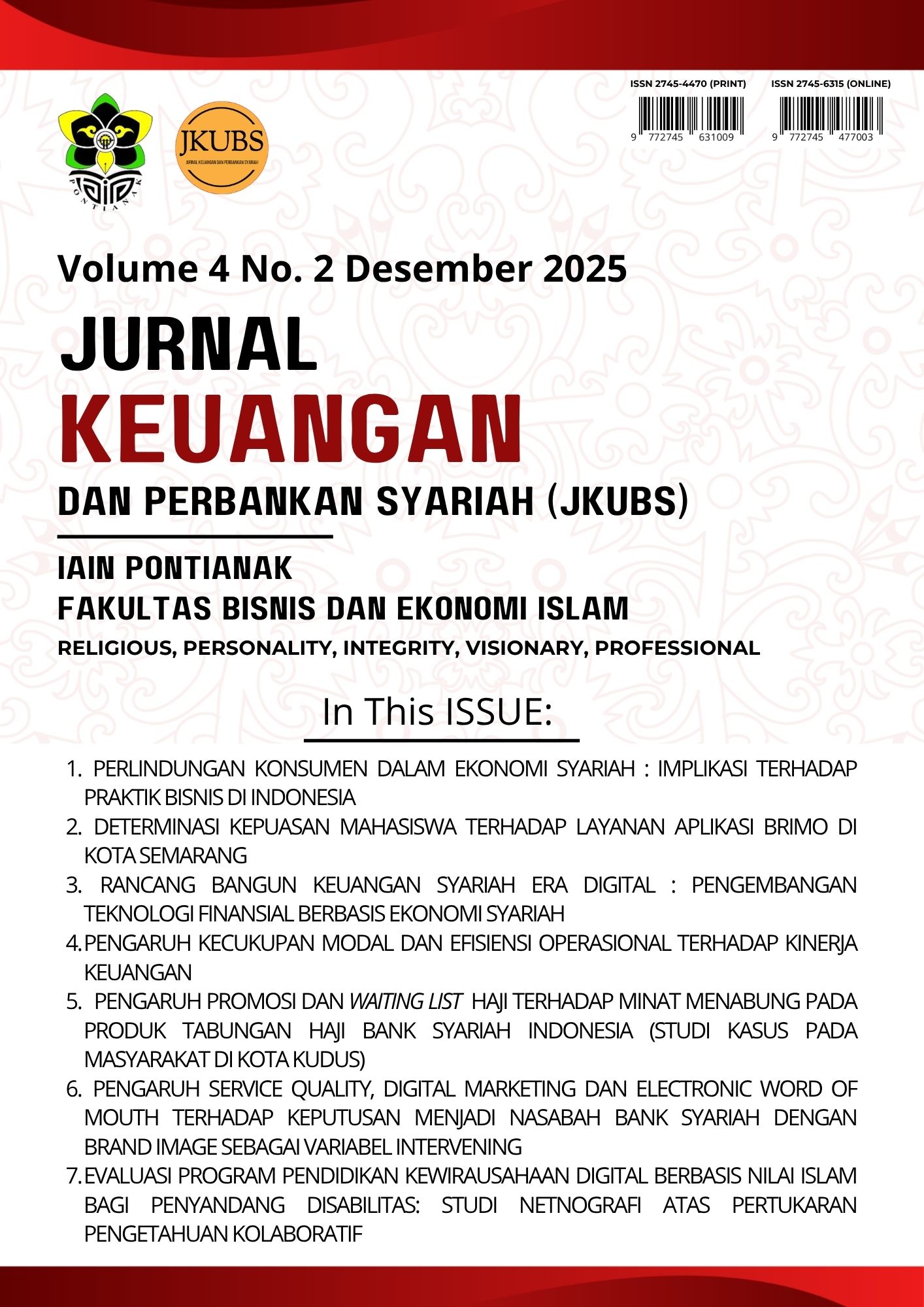
Evaluasi Program Pendidikan Kewirausahaan Digital Berbasis Nilai Islam bagi Penyandang Disabilitas: Studi Netnografi atas Pertukaran Pengetahuan Kolaboratif
Evaluating an Islamic Value-Based Digital Entrepreneurship Education Program for Persons with Disabilities: A Netnographic Study on Collaborative Knowledge Exchange
DOI:
https://doi.org/10.24260/bj94ds04Keywords:
Collaborative Learning, Digital Entrepreneurship, Disability Inclusion, Netnography, Program EvaluationAbstract
Purpose: to evaluate the forms and patterns of collaborative knowledge exchange within YouTube-based digital entrepreneurship communities involving persons with disabilities (PWD) from an Islamic values perspective.
Design/methodology/approach: This study employed a netnographic qualitative design. Comments from five purposively selected YouTube videos centered on disability entrepreneurship narratives were collected and analyzed through reflexive thematic analysis. Coding categories included Emotional Support (EM), Lived Experience (LE), Practical Knowledge Sharing (PKS), and Barriers and Structural Constraints (BS).
Research Findings: The evaluation reveals four interrelated knowledge dimensions: (1) Inspirational Emotional Ecology, (2) Lived Experience as Knowledge, (3) Aspirational Futures and Economic Desire, and (4) Emerging Practical Knowledge Exchange. Online communities function primarily as socio-emotional learning environments. From an Islamic perspective, interactions reflect values of ta'awun (mutual cooperation), ukhuwwah (brotherhood), and ijtihad (striving for improvement).
Contribution/Originality/Novelty: This study proposes a conceptual model integrating Islamic educational principles with inclusive digital entrepreneurship learning. It broadens the understanding of educational evaluation by recognizing that informal community-based interactions constitute meaningful learning processes for marginalized groups, particularly PWD.
References
Atmaca, E., & Gerekten, S. E. (2023). Learning needs of amateur bağlama students: A netnographic analysis on the basis of YouTube experiences. Cumhuriyet International Journal of Education, 12(3), 760–776. https://doi.org/10.30703/CIJE.1282927
Babik, I., & Gardner, E. S. (2021). Factors affecting the perception of disability: A developmental perspective. Frontiers in Psychology, 12. https://doi.org/10.3389/FPSYG.2021.702166
Balcazar, F. E., Murthy, S., Gibbons, T. M., Sefandonakis, A., Renko, M., Harris, S. P., & Caldwell, K. (2023). Supports and barriers that entrepreneurs with disabilities encounter when starting their businesses. Rehabilitation Psychology, 68(1), 91–101. https://doi.org/10.1037/REP0000479
Botelho-Francisco, R. E., & Botelho-Francisco, R. E. (2015). A netnographic approach on digital emerging literacies in the digital inclusion program AcessaSP – Brazil. In Handbook of research on educational technology integration and active learning (pp. 236–263). IGI Global. https://doi.org/10.4018/978-1-4666-8740-0.CH015
Chapra, M. U. (2008). The Islamic vision of development in the light of maqasid al-shari'ah. Islamic Research and Training Institute.
Destriani, T., Murwani, A., & Indria, I. (2024). Netnography study on Covid-19 vaccination on Dedy Corbuzier's YouTube podcast. Multidisciplinary Journals. https://doi.org/10.37676/mj
Jacocks, C., & Bell, G. (2020). Entrepreneurs with disabilities: Making a difference in society through social entrepreneurship. In Management for Professionals (pp. 117–129). Springer. https://doi.org/10.1007/978-3-030-39676-3_8
Jurana, J., & Muliady, H. (2024). Netnography study: Suitability of environmental accounting reporting of PT. Halmahera Persada Lygend on the response of YouTube and Instagram users. International Journal of Environmental, Sustainability, and Social Science, 5(6), 1495–1509. https://doi.org/10.38142/IJESSS.V5I6.1211
Kozinets, R. V., Dolbec, P.-Y., & Earley, A. (2020). Netnographic analysis: Understanding culture through social media data. In U. Flick (Ed.), The SAGE handbook of qualitative data analysis (pp. 262–276). SAGE Publications.
Kozinets, R. V., & Gretzel, U. (2023). Netnography evolved: New contexts, scope, procedures and sensibilities. Annals of Tourism Research, 104, 103693. https://doi.org/10.1016/J.ANNALS.2023.103693
Kozinets, R. V., & Gretzel, U. (2024). Netnography evolved: New contexts, scope, procedures and sensibilities. Annals of Tourism Research, 104, 103693. https://doi.org/10.1016/J.ANNALS.2023.103693
Malhotra, S., Kaur, T., Jain, K., Pandey, P. K., & Sengupta, A. (2025). Inclusive entrepreneurship ecosystem for PwDs: A reflection on SDGs. International Journal of Manpower, 46(4), 736–769. https://doi.org/10.1108/IJM-01-2024-0042
Muhaimin. (2009). Rekonstruksi pendidikan Islam: Dari paradigma pengembangan, manajemen kelembagaan, kurikulum hingga strategi pembelajaran. Raja Grafindo Persada.
Sudarsono, H. (2018). Bank dan lembaga keuangan syariah: Deskripsi dan ilustrasi (4th ed.). Ekonisia.
Downloads
Published
Issue
Section
License
Copyright (c) 2025 Indah Purnama Sari, Izza Karunia Putri

This work is licensed under a Creative Commons Attribution-NonCommercial 4.0 International License.