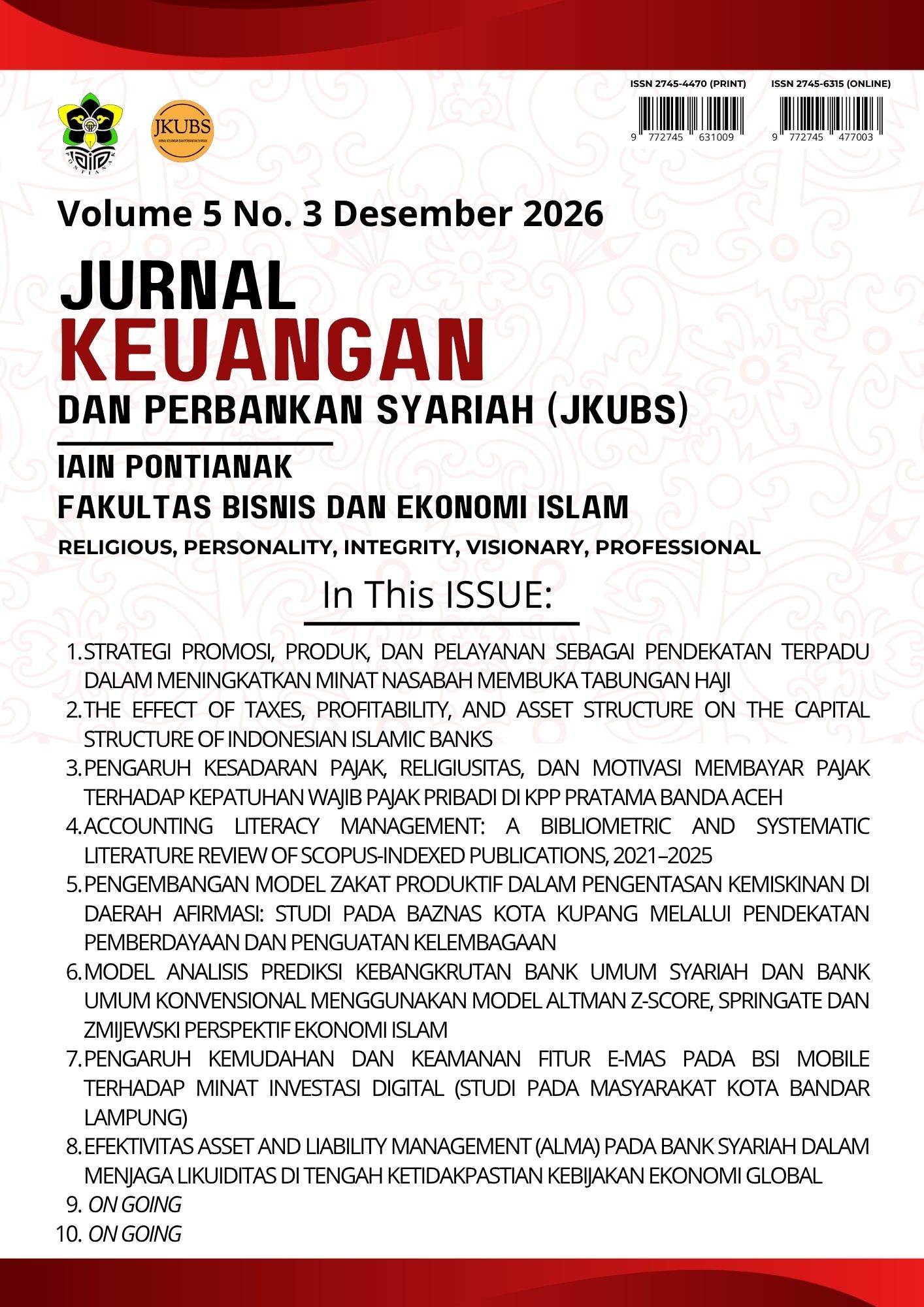
Pengembangan Model Zakat Produktif dalam Pengentasan Kemiskinan di Daerah Afirmasi: Studi pada BAZNAS Kota Kupang melalui Pendekatan Pemberdayaan dan Penguatan Kelembagaan
Developing a Productive Zakat Model for Poverty Alleviation in Affirmative Regions: A Study of BAZNAS Kupang City through Empowerment and Institutional Strengthening Approaches
DOI:
https://doi.org/10.24260/jkubs.v5i3.6827Keywords:
Productive Zakat, Mustahik Empowerment, Institutional Strengthening, Poverty Alleviation, Affirmation RegioAbstract
Purpose: to analyze the development of a productive zakat model for poverty alleviation in affirmation regions, focusing on the empowerment approach and institutional strengthening at BAZNAS Kupang City.
Design/methodology/approach: this study employs a qualitative approach with a case study design, involving the management, amil (zakat collectors), and mustahik (zakat recipients) of BAZNAS Kupang City as research subjects. Data were collected through in-depth interviews, observation, and documentation studies, and were then analyzed using the Miles and Huberman interactive model.
Research Findings: the results show that the development of productive zakat at BAZNAS Kupang City, exemplified by the ZMart program, has already been implemented and has contributed to the economic empowerment of mustahik, although its implementation still requires improvement. The main constraints lie in the limited number of amil available for mentoring, which has resulted in uneven guidance for mustahik, as well as a monitoring and reporting system that remains simple and is not yet supported by adequate information technology.
Contribution/Originality/Novelty: this study contributes to the literature on zakat economics by integrating two approaches that have largely been examined separately, namely mustahik empowerment and institutional strengthening of zakat management organizations, into a single development model tailored to the context of affirmation regions such as Kupang City. This research also offers practical implications for BAZNAS management in designing empowerment strategies and governance practices that are more adaptive to the characteristics of underdeveloped, frontier, and outermost (3T) regions.
References
Alhamuddin, Aziz, Inten, & Mulyani, 2020. (2020). Pemberdayaan Berbasis Asset Based Community. Https://Ejournal.Undiksha.Ac.Id/Index.Php/IJCSL/Article/View/29109, 1(2), 106–134. https://ejournal.undiksha.ac.id/index.php/IJCSL/article/view/29109
Ayu, S., & Argarini, G. M. (2025). Zakat Produktif sebagai Solusi Pengentasan Kemiskinan. Journal of Economic and Islamic Research, 4(1). https://doi.org/10.62730/journalofeconomicandislamicresearch.v4i1.271
Fatmawati, F., Iswandi, H., Fauziah, F., & Herviani, S. (2023). Penguatan Kelembagaan Pada Organisasi Pengelola Zakat Melalui Good Amil Governance (GAG). J-Alif : Jurnal Penelitian Hukum Ekonomi Syariah Dan Budaya Islam, 8(2), 143. https://doi.org/10.35329/jalif.v8i2.4849
Firmansyah, M. A. (2026). Pengelolaan Zakat Berbasis Kelembagaan dan Dampaknya terhadap Pemberdayaan Ekonomi Mustahik. Maliki Interdisciplinary Journal, 4(6), 1364–1372. https://urj.uin-malang.ac.id/index.php/mij/article/view/27559
Kamsina, S., & Khoirudin, R. (2024). Determinan Kemiskinan di Provinsi Nusa Tenggara Timur, Indonesia. Jurnal Genesis Indonesia, 3(01), 15–24. https://doi.org/10.56741/jgi.v3i01.477
Kupang, B. (2026). Program Baznas Kupang. BAZNAS Kupang. https://www.baznaskupang.com/program/
Layungsari, D. D., & Yusfi, R. H. (2026). Konstelasi Faktor Penyebab Kemiskinan di Provinsi Nusa Tenggara Timur. Paradoks : Jurnal Ilmu Ekonomi, 9(3), 542–554. https://doi.org/10.57178/paradoks.v9i3.2508
Noviana, I., & Suryani, I. L. (2026). Strategi Pemberdayaan Mustahik Berbasis Zakat Produktif pada BAZNAS Kabupaten Jepara. AHKAM: Jurnal Hukum Islam Dan Humaniora, 5(3), 2439–2460. https://doi.org/10.58578/ahkam.v5i3.10472
Purnamasari, H., Putra, A. D., Awaliyah, R., & Yamin, A. (2024). Penerapan Manajemen Zakat Produktif Melalui Program ZMART Dalam Meningkatkan Ekonomi Umat di Kota Kupang. Ekobis Syariah, 8(2), 1. https://doi.org/10.22373/ekobis.v8i2.26466
Sukmawati, Y. I., Agrosamdhyo, R., & Kurniawati. (2022). Efektivitas Zakat Produktif dalam Pemberdayaan Usaha Ekonomi Mustahiq pada Badan Amil Zakat Nasional (BAZNAS) Provinsi Bali. Maisyatuna: Jurnal Ekonomi Syariah, 3(4), 27–35. https://doi.org/10.53958/mt.v3i4.132
Syariah, F., Hukum, I., Syekh, U. I. N., Hasan, A., Addary, A., Januari-juni, E., Hukum, J., Fakultas, E., Hukum, I., Syekh, U. I. N., Hasan, A., Addary, A., Volume, P., & Januari-juni, E. (2025). Jurnal Yurisprudentia. 11(27), 1–23.
Teori Institusional. (2015). Kuliah Publik. https://kuliahpublik.blogspot.com/2015/04/teori-institusional.html
Zalikha, S. (2016). Pendistribusian Zakat Produktif Dalam Perspektif Islam. Jurnal Ilmiah Islam Futura, 15(2), 304. https://doi.org/10.22373/jiif.v15i2.547
Zuchroh, I. (2022a). Zakat Produktif: Kebijakan Pengelolaan Keuangan Publik sebagai Instrumen Pengentasan Kemiskinan di Indonesia. Jurnal Ilmiah Ekonomi Islam, 8(3), 3067. https://doi.org/10.29040/jiei.v8i3.6387
Zuchroh, I. (2022b). Zakat Produktif: Kebijakan Pengelolaan Keuangan Publik sebagai Instrumen Pengentasan Kemiskinan di Indonesia. Jurnal Ilmiah Ekonomi Islam, 8(3), 3067–3073. https://doi.org/10.29040/jiei.v8i3.6387
Downloads
Published
Issue
Section
License
Copyright (c) 2026 Muhammad Kadri, Awan Sutrisno

This work is licensed under a Creative Commons Attribution-NonCommercial 4.0 International License.