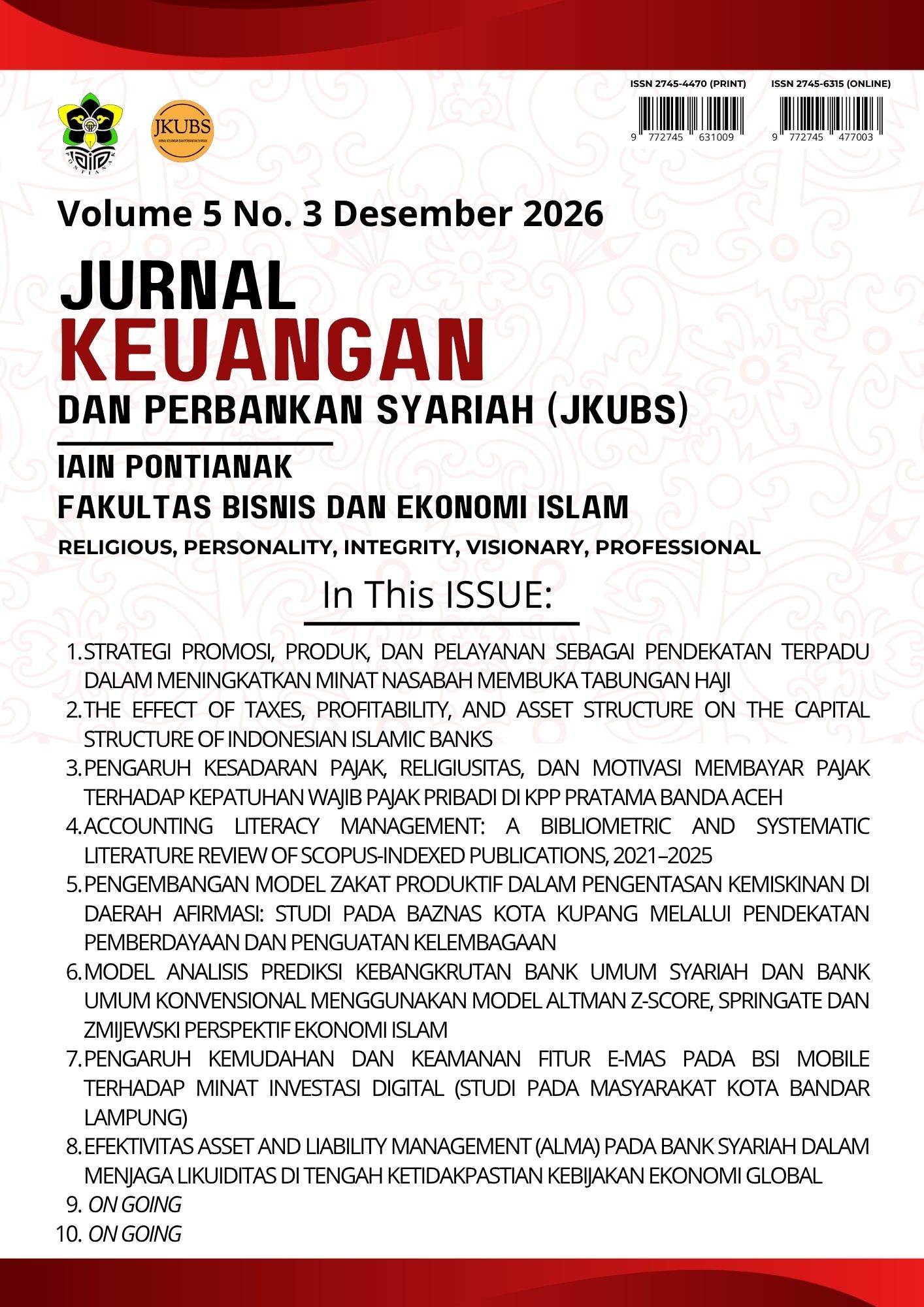
Efektivitas Asset And Liability Management (ALMA) pada Bank Syariah dalam Menjaga Likuiditas di tengah Ketidakpastian Kebijakan Ekonomi Global
The Effectiveness of Asset and Liability Management (ALM) in Islamic Banks in Maintaining Liquidity amid Global Economic Policy Uncertainty
DOI:
https://doi.org/10.24260/jkubs.v5i3.6965Keywords:
ALMA, Liquidity, Sharia Commercial Banks, Global Economic Policy UncertaintyAbstract
Purpose: This study aims to analyze the effect of Asset and Liability Management (ALMA) effectiveness on the liquidity of Indonesian Islamic Commercial Banks (ICBs) and examine the moderating role of Global Economic Policy Uncertainty (GEPU), while considering profitability and bank size.
Design/methodology/approach: This study employs a quantitative explanatory approach using quarterly secondary data from six ICBs in Indonesia covering 2023Q1–2026Q1, selected through purposive sampling. ALMA effectiveness is measured using a composite index comprising liquid assets, funding stability, financing–deposit balance, capital adequacy, and asset quality. Liquidity is measured using the Liquid Assets to Deposits Ratio (LADR), while profitability and bank size are represented by ROA and Total Ln, respectively. Hypotheses are tested through regression and interaction analyses.
Research Findings: ALMA has a positive and significant effect on liquidity (B = 6.706; p < 0.001). The ALMA×GEPU interaction is also positive and significant (B = 0.009; p = 0.038), indicating that the positive relationship between ALMA and liquidity tends to strengthen at higher levels of GEPU. ALMA, ROA, and SIZE are jointly significant predictors of liquidity (F = 241.681; p < 0.001; R² = 0.907). However, in the simultaneous moderation model, the ALMA×GEPU and ROA×GEPU interactions are not significant, while SIZE×GEPU cannot be estimated due to collinearity.
Contribution/Originality/Novelty: The findings highlight the relevance of strengthening ALMA in managing ICB liquidity and the need for further testing of global uncertainty effects using a more appropriate model specification.
References
Abou-El-Sood, H., & El-Ansary, O. (2017). Asset-liability management in Islamic banks: Evidence from emerging markets. Pacific Accounting Review, 29(1), 55–78. https://doi.org/10.1108/PAR-04-2016-0050
Alzoubi, T. (2017). Determinants of liquidity risk in Islamic banks. Banks and Bank Systems, 12(3), 142–148. https://doi.org/10.21511/bbs.12(3).2017.10
Baker, S. R., Bloom, N., & Davis, S. J. (2016). Measuring economic policy uncertainty. The Quarterly Journal of Economics, 131(4), 1593–1636. https://doi.org/10.1093/qje/qjw024
Bank Indonesia. (2026). BI-Rate naik 25 bps menjadi 5,50%: Kebijakan lanjutan memperkuat stabilitas nilai tukar Rupiah. https://www.bi.go.id/id/publikasi/ruang-media/news-release/Pages/sp_2811926.aspx
Bank Indonesia. (2026). Laporan Perekonomian Indonesia Tahun 2025. https://www.bi.go.id/id/publikasi/laporan/Pages/LPI_2025.aspx
Basel Committee on Banking Supervision. (2008). Principles for sound liquidity risk management and supervision. Bank for International Settlements. https://www.bis.org/publ/bcbs144.htm
Berger, A. N., & Bouwman, C. H. S. (2009). Bank liquidity creation. The Review of Financial Studies, 22(9), 3779–3837. https://doi.org/10.1093/rfs/hhn104
Berger, A. N., & Bouwman, C. H. S. (2017). Bank liquidity creation, monetary policy, and financial crises. Journal of Financial Stability, 30, 139–155. https://doi.org/10.1016/j.jfs.2017.05.001
Berger, A. N., Guedhami, O., Kim, H. H., & Li, X. (2022). Economic policy uncertainty and bank liquidity hoarding. Journal of Financial Intermediation, 49, 100893. https://doi.org/10.1016/j.jfi.2020.100893
Berger, A. N., & Sedunov, J. (2017). Bank liquidity creation and real economic output. Journal of Banking & Finance, 81, 1–19. https://doi.org/10.1016/j.jbankfin.2017.04.005
Bilgin, M. H., Danisman, G. O., Demir, E., & Tarazi, A. (2021). Economic uncertainty and bank stability: Conventional vs. Islamic banking. Journal of Financial Stability, 56, 100911. https://doi.org/10.1016/j.jfs.2021.100911
Diamond, D. W., & Dybvig, P. H. (1983). Bank runs, deposit insurance, and liquidity. Journal of Political Economy, 91(3), 401–419. https://doi.org/10.1086/261155
Ghazali, A. W., Sulistyowati, Ananta, H. W., & Putri, A. A. (2025). Peran Asset And Liability Management (Alma) dalam Menjaga Stabilitas Keuangan Bank Syariah. Tasharruf : Journal of Islamic Economics and Business, 6(1), 1–12. https://doi.org/10.55757/tasharruf.v6i1.1147
Gujarati, D. N., & Porter, D. C. (2009). Basic econometrics (5th ed.). McGraw-Hill. https://www.mheducation.com/highered/product/basic-econometrics-gujarati-porter/M9780073375779.html
Hadibrata, M., Septiana, G., Yuliandari, P., & Nasution, F. B. (2026). Efektivitas ALMA dalam Menjaga Liquiditas dan Ketahanan Bank Syariah di Tengah Tekanan Ekonomi (Case Study BPR Syariah). Jurnal Ilmiah Raflesia Akuntansi, 12(1), 166–172. https://doi.org/10.53494/jira.v12i1.1330
Husted, L., Rogers, J., & Sun, B. (2020). Monetary policy uncertainty. Journal of Monetary Economics, 115, 20–36. https://doi.org/10.1016/j.jmoneco.2019.07.009
Huynh, J. (2024). Uncertainty and the transmission of monetary policy via bank liquidity creation. Managerial Finance, 50(11), 1857–1877. https://doi.org/10.1108/MF-03-2024-0162
International Monetary Fund. (2026). World Economic Outlook, April 2026: Global economy in the shadow of war. https://www.imf.org/en/publications/weo/issues/2026/04/14/world-economic-outlook-april-2026
Islamic Financial Services Board. (2012). IFSB-12: Guiding principles on liquidity risk management for institutions offering Islamic financial services. https://www.ifsb.org/wp-content/uploads/2023/10/IFSB-12-March-2012_En.pdf
Islamic Financial Services Board. (2022). Technical note on Sharīʻah-compliant liquidity management tools. https://www.ifsb.org/wp-content/uploads/2023/11/Final-TN-5-Technical-Note-on-Shariah-compliant-Liquidity-Management-Tools.pdf
Islamic Financial Services Board. (2025). Islamic Financial Services Industry Stability Report 2025. https://www.ifsb.org/wp-content/uploads/2025/05/IFSI-Stability-Report-2025.pdf
Ismail, I., Sukmana, R., Rahman, M. A., & Kholid, M. N. (2024). Impact of liquidity creation on real economic output: Evidence from full-fledged Islamic banks and hybrid conventional banks. Journal of Islamic Monetary Economics and Finance, 10(2), 397–426. https://doi.org/10.21098/jimf.v10i2.2147
Otoritas Jasa Keuangan. (2025). Laporan Perkembangan Keuangan Syariah Indonesia 2024. https://ojk.go.id/id/kanal/syariah/data-dan-statistik/laporan-perkembangan-keuangan-syariah-indonesia/Pages/Laporan-Perkembangan-Keuangan-Syariah-Indonesia-2024.aspx
Otoritas Jasa Keuangan. (2026). Snapshot Perbankan Syariah Indonesia Desember 2025. https://ojk.go.id/id/berita-dan-kegiatan/publikasi/Documents/Pages/Snapshot-Perbankan-Syariah-Indonesia-Des-2025/Snapshot%20Perbankan%20Syariah%20Indonesia%20Desember%202025.pdf
Pham, H. S. T., Nguyen, T. T. T., & Nguyen, D. T. (2021). Monetary policy and bank liquidity creation: Does bank size matter? International Economic Journal, 35(3), 345–367. https://doi.org/10.1080/10168737.2021.1901762
Siyamto, Y., Saputra, A., & Putri, R. A. (2023). Economic policy uncertainty: Impact on financing risk and total financing of Islamic banks in Indonesia. International Journal of Economics, Business and Accounting Research, 7(3). https://jurnal.stie-aas.ac.id/index.php/IJEBAR/article/view/9278
Viverita, V., Bustaman, Y., & Danarsari, D. N. (2023). Liquidity creation by Islamic and conventional banks during the Covid-19 pandemic. Heliyon, 9(4), Article e15136. https://doi.org/10.1016/j.heliyon.2023.e15136
Wooldridge, J. M. (2010). Econometric analysis of cross section and panel data (2nd ed.). MIT Press. https://mitpress.mit.edu/9780262232197/econometric-analysis-of-cross-section-and-panel-data/
Downloads
Published
Issue
Section
License
Copyright (c) 2026 Novita Novita, Suci Atika , Tari Indriani , Monica Olivia

This work is licensed under a Creative Commons Attribution-NonCommercial 4.0 International License.