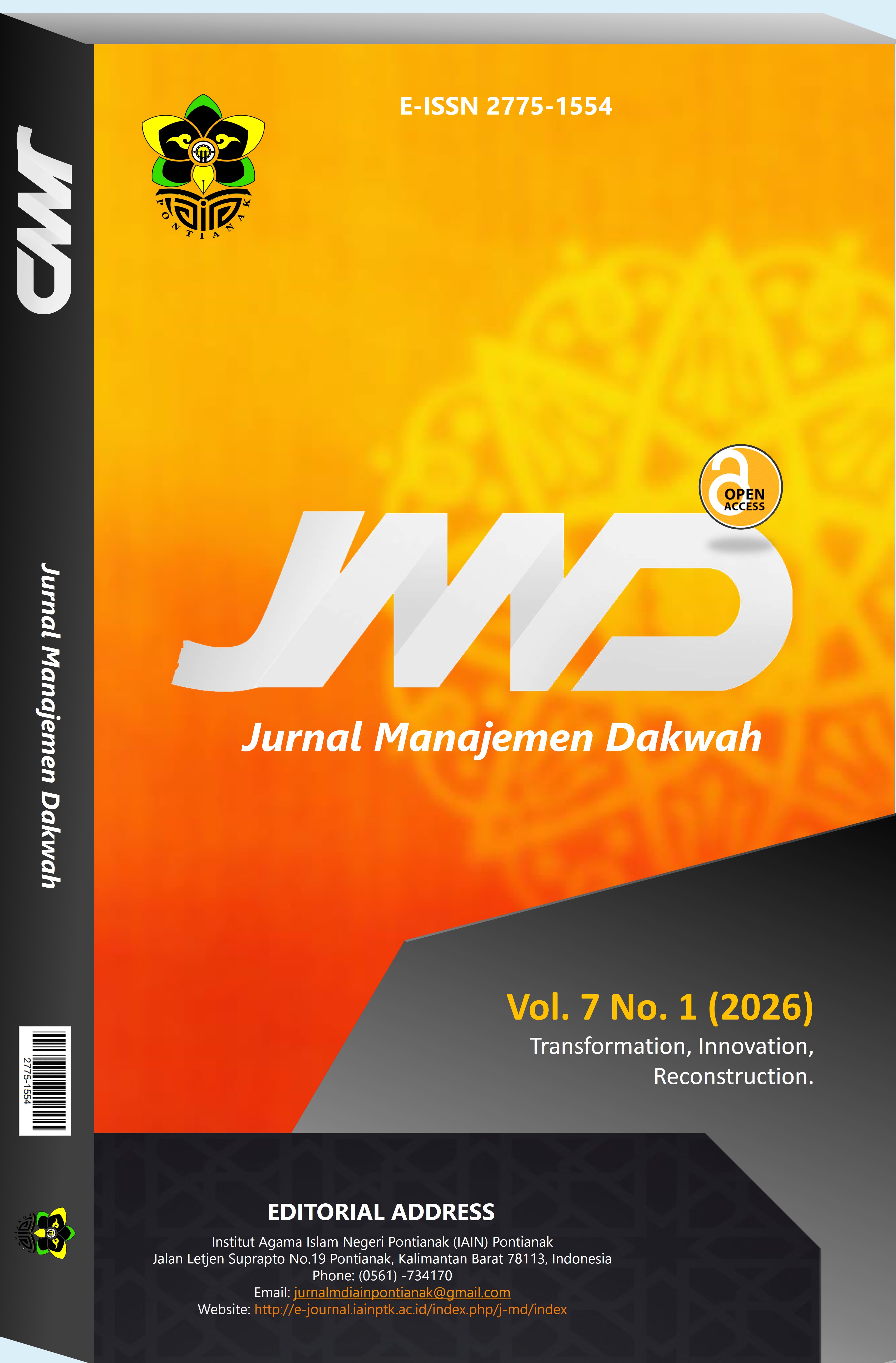
DAKWAH STRATEGIES OF ISLAMIC WOMEN'S ORGANIZATIONS IN INDONESIA–MALAYSIA BORDER COMMUNITIES: A RESOURCE MOBILIZATION PERSPECTIVE
DOI:
https://doi.org/10.24260/1zbge084Keywords:
Strategi dakwah, organisasi perempuan, kawasan perbatasanAbstract
This study aims to analyze the dakwah strategies employed by Islamic women’s organizations in the Indonesia–Malaysia border region of West Kalimantan from a Resource Mobilization Theory perspective. Specifically, it examines the challenges faced by these organizations, the strategies they employ to address such challenges through resource mobilization, and the resulting impacts of their dakwah activities. This research adopts a qualitative design using a phenomenological approach. Data were collected through in-depth interviews, participant observation, and document analysis involving organizational leaders and dakwah practitioners from Badan Kontak Majelis Taklim (BKMT) and Persaudaraan Muslimah (Salimah) operating in Sambas Regency, West Kalimantan. The findings reveal that both organizations implement emotional, rational, and sensory dakwah strategies as conceptualized by Al-Bayanuni. Emotional strategies are reflected in persuasive communication and family development programs, rational strategies are manifested through religious study circles and strengthening religious understanding, while sensory strategies are implemented through social services and community empowerment initiatives. From the perspective of Resource Mobilization Theory, these strategies demonstrate the organizations’ ability to mobilize social, moral, material, and cultural resources through community solidarity, social networks, cadre development, and grassroots empowerment. These strategies are contextually adapted to address various challenges, including geographical isolation, inadequate infrastructure, limited financial and human resources, low religious participation, youth-related issues, and weak family resilience. The study further finds that these dakwah activities contribute to strengthening community spirituality, increasing social solidarity and participation, promoting women’s economic empowerment, and enhancing organizational capacity. Theoretically, this study extends the application of Resource Mobilization Theory to Islamic women’s dakwah movements in border communities. Practically, the findings provide insights for policymakers and Islamic organizations in developing sustainable community-based dakwah programs in peripheral and border regions. The originality of this study lies in its integration of dakwah strategy and resource mobilization perspectives within the context of Islamic women’s organizations operating in the Indonesia–Malaysia borderlands
References
Abang Admin. (2026). PA Sambas Perkuat Layanan Publik, Data Perceraian Jadi Sorotan Media.
Apridayanti, R., Ghozali, M., & Ariskawanti, E. (2022). Gerakan Persaudaraan Muslimah (Salimah) dalam Memberi Pendidikan Keluarga Kepada Masyarakat. FONDATIA, 6(4), 1182–1193. https://doi.org/10.36088/fondatia.v6i4.2388
Arifin, A., & Yuniarsih, R. (2022). Developing Border Area: A Study of the Village Internet Program in Kaliau Village, Sambas Regency. Jurnal Pemberdayaan Masyarakat: Media Pemikiran Dan Dakwah Pembangunan, 6(1), 47–68. https://doi.org/10.14421/jpm.2022.061-03
Aziz, M. Ali. ,. (2017). Ilmu Dakwah (6th ed., Vol. 1). Kencana.
Bondahara, R., Amin, S., & Abdillah, F. (2023). Strategi Kepemimpinan Bkmt Kabupaten Raja Ampatdalam Penguatan Pendidikan Islam Di Kabupaten Raja Ampat. Transformasi, 7. https://doi.org/10.47945/transformasi.v7i1.1381
Brunet-Jailly, E. (2022). Cross-border cooperation: a global overview. Alternatives, 47(1), 3–17. https://doi.org/10.1177/03043754211073463
Bungin, B., & Irwanti, M. (2022). Qualitative Data Analysis (1st ed., Vol. 1). Kencana.
Casmini, C. (2020). Analysis of Muallaf ‘Aisyiyah Da’wah Strategy. Ilmu Dakwah: Academic Journal for Homiletic Studies, 14(1), 151–166. https://doi.org/10.15575/idajhs.v14i1.9238
Cholis, N. (2022). Strategi Dakwah Dalam Mengatasi Patologi Sosial Dalam Pengatasan Penyakit Masyarakat. Jurnal Dakwah Dan Komunikasi, 7(2). https://doi.org/10.29240/jdk.v7i2.5772
Creswell, J. W. . (2007). Qualitative inquiry and research design : choosing among five traditions. SAGE.
Efendi, Z. (2021). Komunikasi penyiaran dakwah dalam sejarah islamisasi di daerah perbatasan Indonesia-Malaysia pada masa kerajaan. Islamic Communication Journal, 6(2), 233–249. https://doi.org/10.21580/icj.2021.6.2.7527
Fadil, M. I., Hudaya, H., & Nor, A. (2024). Ustad Qasim’s Preaching Strategy Based on Local Wisdom in the Meratus Hinterland: Challenges and Solutions. Al Hadharah, 23(2), 173–194. https://doi.org/10.18592/alhadharah.v23i2.13129
Fauzia, S., Purwana, D., & Lubis, H. (2022). Leadership Strategic Role of Tutty Alawiyah in Development of Islamic Da’wah Through the Organization of Badan Kontak Majelis Ta’lim in Indonesia. International Journal of Multicultural and Multireligious Understanding, 9(4).
Hidayat, A. N., Purwandari, E., & Putri, D. (2024). The Role and Da’wah Strategies of Islamic Religious Counselors in Enhancing the Religiosity of Women at the Al-Hidayah Taklim Assembly. Ilmu Dakwah: Academic Journal for Homiletic Studies, 18(2), 413–438. https://doi.org/10.15575/idajhs.v18i2.38648
Ibrahim. (2018). Metodologi Penelitian Kualitatif (M. E. Kurnanto, Ed.; 1st ed., Vol. 1). Alfabeta.
Jusup, N. B. (2023). Da’wah Strategy for Jabatan Hal Ehwal Agama Islam Negeri Sabah (JHEAINS) in the Tuaran Region Towards Muallaf. Ilmu Dakwah: Academic Journal for Homiletic Studies, 17(1), 223–242. https://doi.org/10.15575/idajhs.v17i1.26225
Masri, M. R. F., Sri Hidayati, Prasojo, Z. H., Abdillah, Z., & Zarbaliyev, H. (2025). Religious Challenges and Guidance for Dayak Muslim Converts in the Indonesia–Malaysia Border Region. Jurnal Theologia, 36(1), 141–160. https://doi.org/10.21580/teo.2025.36.1.26839
Mauvizar, E., Rahim, A., & Zulisa, E. (2022). Opportunities and Strategies for Da’wah of Muhammadiyah Aceh Organizations against Youth Trends in Coffee Shops in Banda Aceh City. BIRCI-Journal, 5(4). https://doi.org/10.33258/birci.v5i4.7033
McCarthy, J., & Zald, M. (1977). Resource Mobilization and Social Movements: A Partial Theory. American Journal of Sociology, 82(6), 1212–1241. chrome-extension://efaidnbmnnnibpcajpcglclefindmkaj/https://users.ssc.wisc.edu/~oliver/SOC924/Articles/McCarthyZald1977.pdf
Miles, B. M., & Huberman, A. M. (1994). Qualitative data Analysis (Vol. 2). Sage Publications.
Muhammad AL Fath Al Bayanuni. (2001). Al Madkhal Ila ’Ilmi Al Da’wah (3rd ed., Vol. 1). Muassasah Ar Risalah.
Murniyanto. (2021). Manajemen dan Strategi Dakwah Pengajian Ikatan Sosial Kerukunan Air Sengak Rejang Lebong. Jurnal Dakwah Dan Komunikasi, 6(1). https://doi.org/10.29240/jdk.v6i1.2962
Mutmainna, H. N., Sos, S., Sos Editor, M., & Mudassir, A. (2024). Strategi Dakwah (A. Mudassir, Ed.; Vol. 1). chrome-extension://efaidnbmnnnibpcajpcglclefindmkaj/https://d1wqtxts1xzle7.cloudfront.net/121332494/Buku_Ajar_Strategi_Dakwah-libre.pdf?1739454029=&response-content-disposition=inline%3B+filename%3DBUKU_AJAR_STRATEGI_DAKWAH.pdf&Expires=1777645056&Signature=Ml1NFNJ2VW1vH1TTgqYdTE07ltCUVD6GUi4yu8-f14AUWc2QkaLlJ2iJ7NI3dvbGcWuRFnYQ0fV9RlqPEpTSBOab60EEGPyhfwJviusQ84Qxig2qJUjABl-XgDSkA0YjkTALSTEiPaxJ8tTYe0spD45KS3WYfIH1BJI1l8joxV2ZIqf617-bPAP6X93JMOcA2fNXS2bWj4JXgr6xiDMRbsfSjGZeeocOw02C6AAhut60Cyx79IuPvDA44BkbUWYwRNhjTX6To2Q0xIUHiefGv39B0m6PJUJ8LQUgiNZye4CeHqPsKSuex005Mq-Ou53pyVAW3q~4LrERJUPhlGkoSA__&Key-Pair-Id=APKAJLOHF5GGSLRBV4ZA
Nazir, M. (2017). Metode Penelitian (R. Sikumbang, Ed.; 11th ed., Vol. 1). Ghalia Indonesia.
Oberschall, A. (1993). Social Movement. Routledge.
Pardianto, P., Syam, N., & Nurdin, A. (2025). Da’wah communication strategy for strengthening wasathiyah Islam in Surabaya: A case study of NU, Muhammadiyah, and Al-Irsyad. Jurnal Ilmu Dakwah, 45(2), 399–420. https://doi.org/10.2158/jid.45.2.28779
Pribadi, S. A. T., & Fahrudin, A. (2021). Strategi Dakwah Pengajian Islam Dalam Suasana Pandemi Covid-19. Tahdzibi, 6(1), 39–45. https://doi.org/10.24853/tahdzibi.6.1.39-46
Putra, B. D., & Yulindrasari, H. (2023). Peran Organisasi Perempuan dalam Ruang Perkotaan. Jurnal Penataan Ruang, 18, 7–13. https://doi.org/10.12962/j2716179x.v18i1.12857
Ramadhani, S., & Tanjung, M. (2023). Communication Strategy in Strengthening Da’wah for the Muallaf Community in North Sumatra. MUHARRIK: Jurnal Dakwah Dan Sosial, 6(1), 87–187. https://doi.org/10.37680/muharrik.v6i1.2728
Ramdhani, A. N., Shaleh, K., & Suhendi, H. (2021). Strategi Dakwah Lembaga Gerakan Ahli Sedekah dalam Penanaman Kesadaran Bersedekah di Bandung. Jurnal Riset Komunikasi Penyiaran Islam, 1(1), 68–71. https://doi.org/10.29313/jrkpi.v1i1.217
Rejeki, F., Murtadho, A., Riyadi, A., Nurhadi, A., & Ernaeny, W. (2026). Egalitarian da’wah as a da’wah strategy. Jurnal Ilmu Dakwah, 46(1), 59–76. https://doi.org/10.2158/jid.46.1.30737
Rohmawati, Y., & Barizi, A. (2021). Religious Moderation In The Recitation Activity Of Muslimat NU: An Effort To Prevent Religious Extremism. Ulul Albab Jurnal Studi Islam, 22(2), 360–376. https://doi.org/10.18860/ua.v22i2.14092
Sahari, S., Gunawan, E., & Murjani, M. (2021). Strategy of Da’wah to Improve Muallaf’s Religiousity in Dologuo Village, Bolaangmongondow Regency. Ilmu Dakwah: Academic Journal for Homiletic Studies, 15(1), 63–80. https://doi.org/10.15575/idajhs.v15i1.12543
Sudaryono. (2017). Metodologi Penelitian (1st ed., Vol. 1). Rajawali Press.
Syarifuddin, M., Riyadi, A., & Ali, M. (2024). Da’wah strategy of the Indonesian Ulema Council in broadcasting wasathiyah islamic values in Wonogiri. Jurnal Ilmu Dakwah, 44(1), 129–148. https://doi.org/10.2158/jid.44.1.20462
Wahid, A. (2019). Gagasan Dakwah Pendekatan Komunikasi antarbudaya (1st ed., Vol. 1). Kencana.
Wahyuni, S. (2019). Qualitative Research Method (3rd ed., Vol. 1). Salemba 4.
Wijaya, G. P., & Lie, G. (2023). Permasalahan Pekerja Migran Di Daerah Perbatasan: Studi Kasus Tenaga Kerja Wanita Di Kabupaten Sambas, Kalimantan Barat. Jurnal Multilingual, 3(4), 563–572. https://doi.org/prefix10.31539
Downloads
Published
Issue
Section
License
Copyright (c) 2026 santa rusmalita, Ibrahim Ibrahim, Muhammad Sulthon, Abdul Razak Abdulroya Panaemalae

This work is licensed under a Creative Commons Attribution-NonCommercial-ShareAlike 4.0 International License.